Roofing is more than a finishing touch to a building! It is a structural decision that directly affects durability, safety and long-term cost efficiency. Selecting the right colour coated sheet requires careful attention to both material quality and dimensional accuracy. The standard size of coloured roofing sheets plays a decisive role in ensuring proper coverage and structural reliability as well as budget control.
It is essential to understand specifications like thickness, width and length when evaluating colour coated roofing sheets. A clear understanding of these technical aspects ensures smoother installation and better long-term performance. This guide explains the standard size of coloured roofing sheets based on manufacturer specifications and practical application needs.
Standard Size of Coloured Roofing Sheets
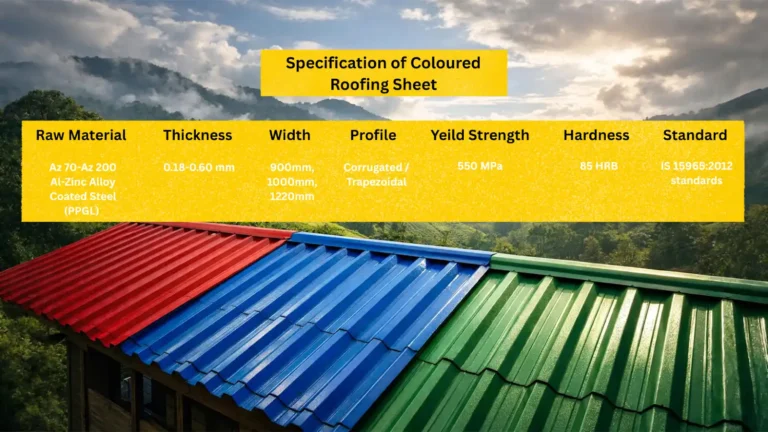
The standard size of coloured roofing sheets follows defined production parameters to maintain uniformity and compatibility across projects. As of 2026, manufacturers continue to provide sheets with specified dimensions & specifications, including standard thickness options, defined overall width, effective width, and customisable lengths.
Understanding these dimensional aspects allows builders and property owners to make informed decisions when selecting a colour coated sheet for their projects.
-
Dimensions & Specifications of Colour Coated Roofing Sheets
The primary dimensions & specifications define how a sheet performs structurally and functionally.
- Thickness: Available in 0.18 – 0.60 mm
- Overall Width: Available in 900. 1000. 1220 mm
- Length: Custom cut as per project requirements.
Thickness directly affects durability and load-bearing performance. Wider effective coverage reduces the number of sheets required. Length customisation ensures fewer horizontal joints, enhancing water resistance and visual uniformity.
-
Standard Width of Coloured Roofing Sheets (Overall Width & Effective Width)
The standard width of coloured roofing sheets is divided into two important measurements:
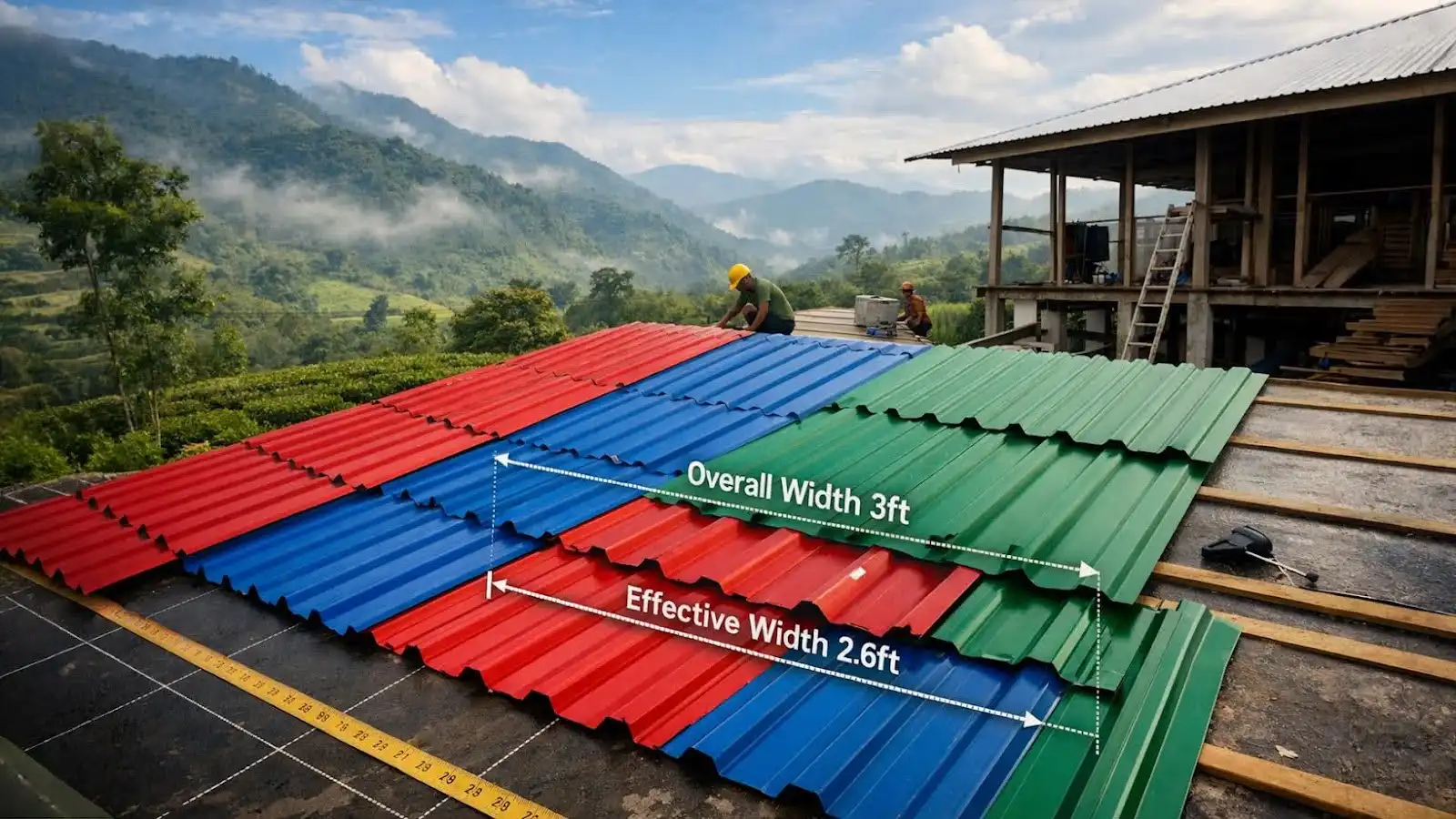
- Overall Width – This is the complete physical width of the sheet.
- Effective Width – This is the actual coverage width after overlapping during installation.
The difference accounts for side lap overlap required for waterproof sealing. When calculating roofing area, effective width must be considered. Using overall width for estimation may lead to under-procurement and installation delays.
-
Standard Size of Coloured Roofing Sheets in Feet and MM (Thickness & Length)
The standard size of coloured roofing sheets in mm refers primarily to thickness and width, while the standard size of coloured roofing sheets in feet relates to sheet length.
- Thickness in mm: 0.30-060 mm
- Width in mm: 1070 mm overall / 1000 mm effective
- Length in feet: Customised (for example, 8 ft, 10 ft, 12 ft or more depending on roof slope).
Selecting 0.30 mm sheets is generally suitable for light residential use, while 0.45-0.50 mm thickness is preferred for industrial applications requiring enhanced strength. Custom lengths reduce joint overlaps and improve structural integrity.
Size Comparison Table (Residential vs Industrial Use)
The following Size Comparison Table (Residential vs Industrial Use) outlines practical differences:
| Application Type | Thickness Range | Length | Width Consideration | Typical Usage |
|---|---|---|---|---|
| Residential Roofing | 0.30-0.40 mm | Custom length (8-12 ft typical) | Based on 1000 mm Effective Width | Homes, garages |
| RIndustrial Roofing | 0.45-0.50 mm | Longer sheets preferred | Based on 1000 mm Effective Width | Factories, warehouses |
Why Effective Width is Always Less Than Overall Width
Understanding why effective width is always less than overall width prevents planning errors. Roofing sheets are overlapped along their edges during installation for structural and waterproofing purposes.
Key reasons include:
- Overlapping prevents rainwater seepage.
- Side laps create a secure fastening zone.
- Structural stability improves under wind load.
- Waterproof sealing enhances durability.
- Consistent alignment ensures long-term performance.
Due to these overlaps, the usable coverage (Effective Width) is slightly smaller than the physical measurement (Overall Width). Accurate calculations must therefore rely on effective width.
Conclusion
Selecting the correct standard size of coloured roofing sheets requires a careful balance between dimensional accuracy and structural performance. A well-chosen colour coated sheet enhances both durability and cost efficiency.
As construction standards continue to evolve in 2026, informed decision-making remains essential. By evaluating specifications thoroughly before purchase, property owners and contractors can ensure that each colour coated sheet contributes to a reliable, weather-resistant, and long-lasting roofing system.
Written and Verified by:

Rhino Roofs
Bio: Leading roofing sheet manufacturer with 50+ years of experience in the Northeast. Rhino Roofs provides color-coated, galvalume and asbestos cement roofing sheets.
FREQUENTLY ASK QUESTIONS
Standard sizes include defined thickness and width measurements, with length typically customised based on roof dimensions.
Overall Width is the full sheet measurement, while Effective Width is the usable coverage after overlapping.
Industrial roofing generally requires higher thickness to support load-bearing and environmental resistance.
Because overlapping reduces usable coverage, calculations must be based on effective width to ensure accurate estimation.